stereo hydrophones in the canal along the Petit-Château arrival center, Mollenbeck, Brussels
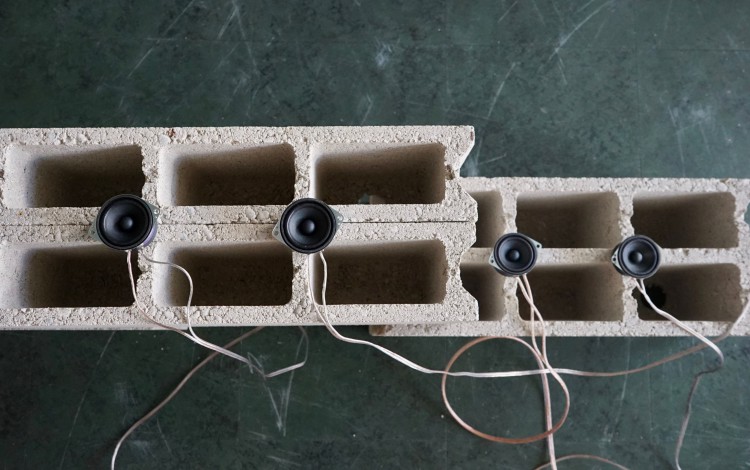
audio excerpt: HERE
Sketches for installation, by architectural designer Emma Canton: Snow in Mória drawings
Snow in Mória is a sound & architectural installation, made in collaboration with designer Emma Canton, currently in production at Overtoon in Brussels. The project was begun in Paris in 2021-2022, in collaboration with asylum-seekers living in the CCAC and Mória refugee camps in Lesvos, Greece. This piece emerges from my participation with the On the Edge group, a collective of artists, activists, curators and lawyers based in Greece, France, Denmark, Switzerland, Germany, Spain, and the UK working on issues of migration and human rights. The goal of the group was to implicate artists and activists, together with social scientists and lawyers, in a course of action against fascism, taking as its spearhead the so called “refugee crisis.” The legal part of our team worked on a project to classify denial of migrants’ safe harbor as a crime against humanity. The artist part of our team developed a range of projects to communicate the experience of migration and camps to a wider public.
This sound sculpture is made in collaboration with Refocus Media Labs, an organization in Lesvos working to equip asylum-seekers with media making skills and equipment. The organization works within refugee camps and runs workshops, facilitates projects and citizen-journalism, etc. Sound has become an important medium because the sharing of images and videos from within the camps has been tightly controlled. Currently, and often in the winter months, the migrant camps on Lesvos (and other tent encampments throughout EU sites) are flooded when the rains come. The piece uses field recordings of water and rain as a flexible signifier to represent the specificity of this site and problem, and to connect it with recurring practices of deportation, migration, and human trafficking in Europe’s history.
The piece takes form as a long corridor made of corrugated sheet metal walls. Transducers mounted inside cause the walls to vibrate with an audio composition made from field recordings of water, rain, fire, and wind. The audio is gathered from important sites of migration and deportation, including recordings sent from the camps in Lesvos and recordings made during a residency at the Cité Internationale des Arts (Paris) of the Le mémorial des Martyrs de la Déportation (memorializing Holocaust deportations from Paris), which is located on the Île de Cité in the center of Paris.
During our residency at Overtoon the project has been further developed by adding field recordings of sites related to deportation, human trafficking, and migration in Belgium generally, and Brussels specifically. The project takes advantage of Overtoon’s location on the canal and in the Mollenbeck neighborhood as sites of import/export and migration. Overtoon is located almost directly across the canal from the “Petit Château” arrival center, where asylum seekers entering Brussels are received. Recordings are also gathered at Belgian port cities such as Ostend, Bruges, Antwerp, from which slave ships departed to Africa. This aspect engages the very live debate in Belgium regarding its historical relationship to colonization and slavery, especially in Congo. Finally, we research and make recordings of sites of deportation during the Holocaust, such as the Kazerne Dossin museum, on the Dyle River in Mechelen. We simultaneously work with Refocus Lab to commission current recordings from asylum-seekers in Greece, updating my existing archives.
In our collective, we discussed critically the ethics and dangers of making work on this topic, especially around the act of visual representation, which can romanticize or dramatize migrants as “our subjects.” This work seeks to avoid such aestheticization and instead uses site-specific sounds (which are both referential and abstract) to bring together current and past questions of expulsion and movement. Walls represent both the solidity of borders (the border walls being erected in the US) and the stability of a safe home. Water is associated with the ephemerality, motion – the movement of bodies across borders, and threat of illness or death from dampness or drowning. The piece is interested in depicting and indexing these sites and issues without directly taking on the role of representing “the migrant.” Rather the recordings will help us to be present at these sites of motion, confronting the listener with these histories and current issues.
The project was prototyped in Paris in 2021-2022 during residencies at Cité internationale des arts and La Générale, and presented in a small form in an expo in Paris in the winter of 2022. Authorship and funding of this piece is shared with the citizen journalists in Lesvos.